Resume Ranker vs an ATS: What Each One Does
Resume Ranker reviews a batch of resumes; an ATS manages the wider hiring process. See when you need either tool, both or neither.
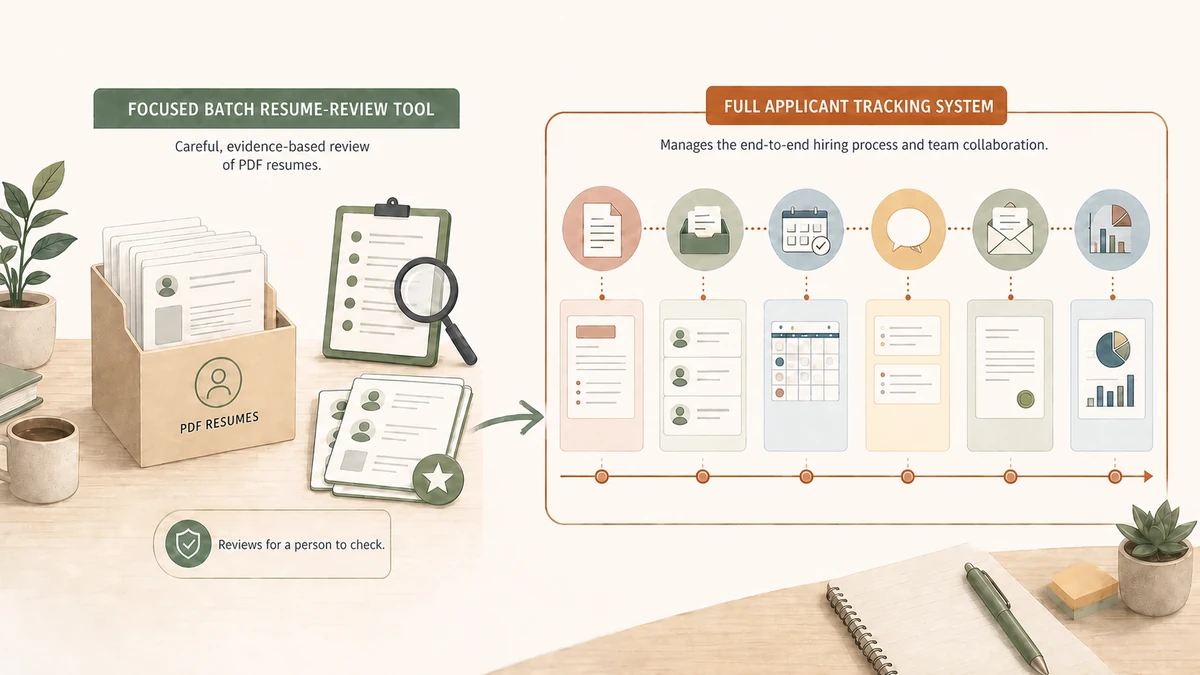
Resume Ranker is not an applicant tracking system.
Resume Ranker handles one part of hiring: reviewing a folder of PDF resumes against a job description and extra criteria. An applicant tracking system, usually called an ATS, keeps track of the wider process from application to final outcome.
You might need neither tool, one of them, or both.
If you have decided against an ATS and want specific options, compare standalone resume-screening tools for small businesses. It covers file formats, costs, exports and a small check before committing.
The difference in one table
| Job to be done | Resume Ranker | A typical ATS |
|---|---|---|
| Publish a job or application form | No | Usually |
| Collect applications into a candidate record | No | Yes |
| Upload a batch of PDF resumes | Yes | Varies |
| Compare the batch with a job description and extra criteria | Yes | Varies by product and plan |
| Show a written review for each resume | Yes | Varies |
| Keep candidates in stages such as New, Interview and Offer | No | Yes |
| Send candidate emails or schedule interviews | No | Usually |
| Gather interview feedback | No | Usually |
| Manage offers and approvals | No | Often |
| Report on sources, stages and hiring activity | No | Usually |
| Download the original PDFs and written reviews together | Yes | Varies |
ATS products differ. Check the exact features, plan and setup of the product you are considering rather than treating this table as a promise about every vendor.
What Resume Ranker does
Resume Ranker is a focused batch-review tool.
You provide:
- PDF resumes;
- the job description;
- any extra written criteria that matter for the role.
It produces an ordered set of reviews with a rating and written explanation for each candidate. You can inspect the original PDFs and download a ZIP containing the resumes and reviews.
The files are kept for the working session rather than becoming a permanent candidate database. Resume Ranker does not receive applications, maintain a hiring pipeline, send messages, schedule interviews or prepare offers.
That smaller scope is useful when the problem in front of you is simply: “We have a folder of resumes. How do we review them against the same requirements without spending the whole day copying information?”
What an ATS does
An ATS is the main workspace for a hiring process.
It commonly stores:
- the open job;
- applications and attached resumes;
- where each candidate is in the process;
- messages and interview arrangements;
- interviewer notes and scorecards;
- offers, decisions and reports.
Greenhouse's current explanation of an ATS describes a process that can include creating the role, posting the job, collecting applications, screening, interviews, offers and reporting. Other products package these jobs differently.
Some ATS products also include resume parsing, filters or AI-assisted matching. If the ATS you already use gives you a clear, checkable batch review, you may not need another screening tool. For example, Greenhouse Talent Matching compares resumes with criteria selected and weighted by the hiring team.
If a vendor is offering an agent that also searches, follows up or moves candidates through stages, read Do you need an AI recruiting agent—or just help reviewing resumes?. It covers action permissions, approval boundaries and what to ask for in a demo, rather than treating an agent as another name for an ATS.
If your question starts with LinkedIn's applicant sorting rather than an ATS, use the Hiring Pro versus a separate resume-tool guide. It focuses on whether an additional review step adds anything to your current workflow.
Choose neither when the process is still small
You may need neither Resume Ranker nor an ATS when:
- you have one occasional vacancy;
- applications arrive in one controlled place;
- one person can review the small pile carefully;
- a simple spreadsheet keeps the evidence and next steps clear;
- nobody is missing messages or losing track of applicants.
Start with the spreadsheet versus resume-screening tool guide. Buying software before writing the job requirements usually gives you a faster version of an unclear process.
Choose Resume Ranker without an ATS when the pile is the problem
Resume Ranker may be enough when:
- resumes already arrive by email, shared drive or another service;
- you are hiring for one role at a time;
- the painful part is reviewing many PDFs consistently;
- you do not need a candidate portal or automated messages;
- you are comfortable keeping the wider process in your existing tools.
This is a common shape for a small business, a short project or a recruiter who receives a folder from a client. The tool deals with the batch. The business still owns communication, interviews, records and decisions.
Choose an ATS when coordination is the problem
An ATS becomes more useful when:
- several roles are open at once;
- applications come from several job boards or sources;
- multiple people need to see the current candidate stage;
- messages, interviews or feedback are being missed;
- approvals and offers need a reliable trail;
- you need reports about the whole hiring process;
- your recordkeeping, access or compliance needs have outgrown shared folders.
An ATS can cost more time to choose and set up because it solves a larger problem. That work may be worthwhile when the alternative is a patchwork of inboxes, calendars and spreadsheets.
Use both when the ATS holds the record but batch review needs help
The two tools can sit beside each other.
For example:
- Applications arrive and remain in the ATS.
- An authorised reviewer exports the appropriate resumes for one role.
- Resume Ranker reviews the PDF batch against the written criteria.
- A person checks the source resumes and corrects any errors.
- The hiring team records the next step in the ATS.
Before moving applicant files between services, check permissions, privacy terms, retention and the rules that apply where you hire. Do not export more information than the review needs.
Neither tool writes good criteria for you
A spreadsheet, Resume Ranker and an ATS can all apply a bad requirement consistently.
Write the must-haves before reviewing the pile. Tie them to the work. Keep “useful extras” separate from automatic rejection rules. Treat missing resume evidence as a question where appropriate.
In the United States, the Equal Employment Opportunity Commission's guidance on employment selection procedures says employers remain responsible for selection methods and whether they are job-related. Local rules differ, particularly when automated employment tools or applicant data are involved.
The resume-screening rubric provides a copyable starting point. The guide about what an ATS can do to a resume explains parsing, employer-written knockout questions, filters and AI-assisted scores separately.
The useful answer
Use Resume Ranker when you already have the PDFs and need help reviewing the batch.
Use an ATS when you need one place to collect applications and manage the hiring process.
Use both when the ATS is doing its wider job but resume review is still a bottleneck. Use neither when a small, controlled spreadsheet remains clear and dependable.
The product category matters less than the problem you can name. Choose the smallest tool that solves that problem without hiding the evidence or removing the person responsible for the decision.
AI-assisted research and drafting, grounded in the cited sources. Hiring decisions should remain human-reviewed.
Have a pile of resumes waiting?
Upload the PDFs, paste the job description and your rubric, then use the ranked reviews as a starting point—not an automatic hiring decision.
Rank resumes with Resume Ranker