How to Screen AI-Written Resumes Without Guessing Who Used AI
A practical evidence-first workflow for reviewing AI-written resumes, reducing application noise and deciding what to verify next.
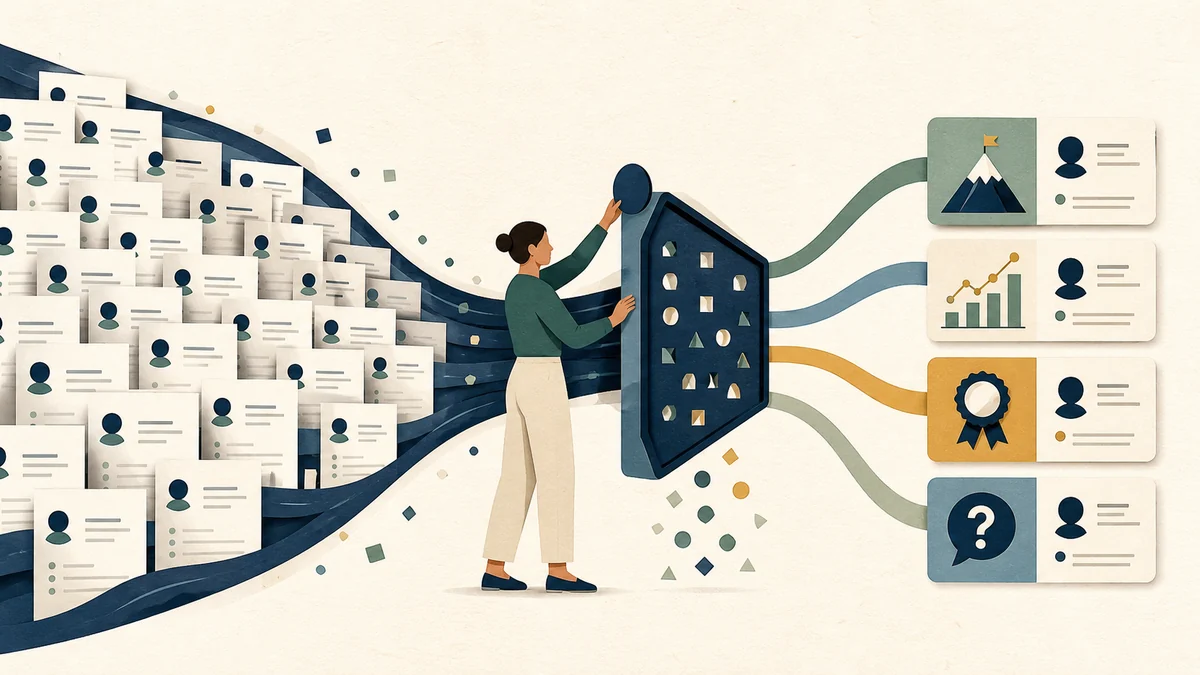
The problem with AI-written resumes is not that the sentences sound suspiciously polished. It is that polished language is getting cheaper while useful evidence is not.
A candidate can use AI to fix grammar and still describe completely real work. Another can write every word personally and exaggerate the substance. A third can send a truthful but generic resume that hides a strong fit. If the first screen becomes a hunt for em dashes, buzzwords or a “ChatGPT voice,” the hiring team is judging writing style while pretending to verify experience.
Call it signal collapse: when nearly everyone can produce the same professional surface, the surface stops helping you distinguish the underlying work.
The pressure is real. In a November 2025 survey of more than 2,000 U.S. hiring managers, Robert Half reported that 67% of HR leaders said AI-generated applications were slowing hiring, while 65% of hiring managers said the surge made candidate skills harder to verify. A separate Greenhouse survey found that 34% of recruiters spent up to half their week filtering spam and junk applications. These are vendor surveys, not a census of every employer, but they describe the same operational problem recruiters are discussing publicly: more applications, more uniform language and less confidence in the signal.
The useful response is not to guess who touched AI. It is to make every resume earn its claims with job-related evidence.
Separate four different problems
“AI resume” is too broad to be a screening category. Split it into the problem you actually need to handle.
| What you are seeing | What it means | What to do |
|---|---|---|
| AI-assisted writing | The candidate may have used a tool for wording, structure or translation | Ignore authorship and score the underlying evidence |
| Unsupported claims | Capabilities or outcomes are stated without enough context to assess them | Record the gap and ask a targeted verification question |
| Low-relevance volume | Many applications do not meet the written requirements | Apply the same job-related rubric to the whole batch and audit the results |
| Fraud or identity inconsistency | Credentials, dates, identity or work history may be misrepresented | Move it into a separate, proportionate verification process |
This distinction prevents two bad shortcuts: treating polished writing as fraud, and treating a fluent resume as proof.
Do not use an AI detector as a knockout rule
AI-text detection is a different problem from evaluating a candidate. It is also not reliable enough to carry a hiring decision.
A 2026 evaluation of 15 detection models found that performance varied heavily by dataset and metric, with poor results on novel human-written text in high-risk domains. OpenAI withdrew its own text classifier in 2023 because of its low accuracy; in the published evaluation it identified only 26% of AI-written text while incorrectly labeling 9% of human-written text as AI-written.
Even a perfect authorship label would not answer the hiring question. “AI assisted” does not tell you whether the experience is true, relevant or at the required level. If a detector score appears anywhere in the process, treat it as an unverified signal that cannot reject or downgrade a candidate by itself.
The same applies to human guesses. None of these is reliable evidence of job fit or deception:
- polished grammar;
- repeated action verbs;
- a conventional summary paragraph;
- an em dash;
- clean formatting;
- close keyword alignment with the job description;
- writing that sounds more fluent than the reviewer expected.
That last assumption is especially dangerous. Editing tools, translators, coaches and templates can all change the surface of a resume. Score what the document claims and supports—not whether the prose matches your intuition about its author.
Use an evidence-density rubric
For each important criterion, give the resume an evidence level from 0 to 3. Do not score prose quality unless writing is itself a job-related requirement.
| Level | Evidence on the resume | Reviewer action |
|---|---|---|
| 0 | Only a skill name, adjective or unsupported claim | Mark “not demonstrated”; do not invent context |
| 1 | A relevant task is named, but ownership, setting or scope is unclear | Keep as possible evidence and write one question to verify |
| 2 | The resume connects the capability to a specific role, project, customer, system or responsibility | Count as credible evidence, subject to normal verification |
| 3 | It adds a result, constraint, decision, scale or repeated example that makes the claim meaningfully testable | Count as strong resume evidence and carry the detail into the next stage |
This is not a truth score. A level 3 claim can still be exaggerated, and a level 0 can hide real ability that the candidate did not include. The scale answers a smaller question: how much job-relevant evidence does this document give us?
A worked example
Suppose the role needs someone who can own a production data pipeline.
Generic claim: Results-driven data engineer with a proven track record of building scalable pipelines and delivering cross-functional impact.
That sounds competent but provides almost nothing to inspect. It is level 0 or 1 depending on the surrounding resume.
Evidence-rich claim: Owned the nightly pricing pipeline for 14 regional storefronts; moved validation ahead of warehouse loading and reduced failed runs from several per week to fewer than one per month.
Now the reviewer has a setting, ownership, an intervention and an outcome. The wording may still have been edited by AI. It does not matter. The claim is level 3 resume evidence because the next interviewer can ask what failed, what changed, how the rate was measured and what the candidate personally did.
A 12-minute calibration before the full batch
Do this once per role, not once per candidate.
- Choose three to five job outcomes. Use the real work, not a list of personality adjectives.
- Define levels 0–3 for each outcome. Include one example of what credible evidence could look like.
- Score five varied resumes independently. Use two reviewers if possible.
- Compare evidence, not just totals. A two-point disagreement usually exposes an ambiguous criterion or an assumption.
- Rewrite the criterion before continuing. Then rescore the affected examples.
This is the same basic discipline behind skills-based screening. In its Job Outlook 2026 survey, NACE found that 70% of participating employers used skills-based hiring and 65% used it during screening. “Skills-based” only becomes useful when the team defines what evidence it will recognize.
Review the batch in three passes
Pass 1: remove only defensible non-matches
Check requirements that genuinely prevent the person from doing the job now: a required license, unavoidable location, work authorization where lawfully relevant, or another written necessity. Keep these screen-outs sparse. A preferred degree, a famous employer or a perfect title match is not automatically a necessity.
Pass 2: score evidence, not confidence
Apply the same 0–3 anchors to every resume. For each score, store the exact supporting phrase or mark it “not stated.” If software helps, require it to show the resume evidence beside every rating.
Review a sample from the high, middle and low ends. This catches a rubric that rewards keyword repetition, mistakes missing information for inability, or overweights one conventional career path.
Pass 3: create a verification queue
Do not solve every uncertainty during the resume screen. Carry the important ones forward.
Criterion: production data-pipeline ownership
Evidence level: 2
Resume evidence: “Maintained ETL services for the pricing team”
Verify next: What part did you own, and what happened when the pipeline failed?
The queue is more valuable than an “AI probability.” It tells the recruiter why the candidate advanced and gives the next assessor a question connected to the job.
What deserves escalation
Escalate inconsistencies, not vibes.
Examples include:
- dates, employers or credentials that conflict within the application;
- a claim involving an internal product or customer that could not plausibly belong to the candidate;
- multiple applications with the same unusual work history or near-identical specific claims;
- a resume, application profile and later identity check that refer to different people;
- a candidate who cannot explain a central claim after receiving a clear, accessible opportunity to do so.
One signal should rarely decide the case. Use a documented verification path appropriate to the role and jurisdiction, and apply comparable checks consistently. Resume screening is not identity verification, a background check or a work sample; those stages have different purposes and legal boundaries.
In the United States, the EEOC says employers should screen applications consistently and ensure that practices with an especially negative effect on protected groups can be justified under the law. Its separate AI guidance also warns that algorithmic tools may screen out qualified people with disabilities and that employers need a process for reasonable accommodations. Local rules vary, so treat this guide as workflow advice rather than legal advice.
A copyable note for every shortlisted resume
Use four fields:
Job outcome:
Evidence level (0–3):
Exact resume evidence:
Question or check for the next stage:
That note survives whatever tool wrote the prose. It also makes the human decision reviewable: another person can challenge the criterion, the score or the cited evidence instead of arguing with an opaque “fit” label.
The short version
- Do not reject candidates because a resume looks AI-written.
- Separate assisted writing, weak evidence, irrelevant volume and fraud.
- Score job-related evidence with anchored levels.
- Keep the exact supporting text beside every rating.
- Audit high, middle and low results from the batch.
- Move important uncertainties into structured questions or checks.
- Keep people responsible for the shortlist and give candidates an accessible way to demonstrate the work.
AI has made professional-sounding applications abundant. Hiring teams do not need a better prose detector. They need a better bridge from claims to evidence.
If the immediate problem is applying one evidence rubric to a folder full of PDFs, Resume Ranker can rank the batch and show resume-grounded reviews for a person to inspect. It should organize attention—not decide who gets hired.
AI-assisted research and drafting, grounded in the cited sources. Hiring decisions should remain human-reviewed.
Have a pile of resumes waiting?
Upload the PDFs, paste the job description and your rubric, then use the ranked reviews as a starting point—not an automatic hiring decision.
Rank resumes with Resume Ranker